The High-Conversion Sales Blueprint:
Engineering Revenue Growth via Behavioral Economics
For many B2B organizations, revenue growth gets treated as an activity problem. When numbers stall, the response is predictable: hire more reps, make more calls, send more emails.
That approach doesn’t fix broken sales systems. It just pushes more volume through them—driving up cost, burnout, and inconsistency while returns flatten out.
At Rose Garden Consulting, we reject the notion that sales is purely a numbers game. Instead, we view sales as an execution problem. When a bridge fails, engineers do not simply add more concrete; they analyze the structural integrity and actual points of failure. Similarly, when revenue stalls, adding more salespeople to a broken process only accelerates the failure.
The organizations that successfully scale don’t do it by working harder; they scale by aligning their sales architecture with how people think and react under pressure. This article outlines a systemic approach to breaking the "Revenue Plateau"—not by doing more, but by converting more of what you already have.
The Blueprint Defined
The High-Conversion Sales Blueprint is an approach that treats sales as a scientific process rather than an art form. It focuses on increasing sales conversion rates by restructuring the sales funnel to prioritize disqualification, applying behavioral economics to influence buyer decision-making, and optimizing team performance through judgment-based coaching rather than activity management.

The Revenue Plateau: Why Traditional Models Fail to Scale

Most B2B companies experience a predictable crisis. In the early days, revenue is driven by founder-led sales. The founder, possessing deep domain expertise and passion, closes deals through sheer force of will and intuition. However, as the company grows and hires a sales team, conversion rates plummet.
This is the Revenue Plateau. It typically occurs between $2M and $20M in ARR.
Traditional sales models fail to break this plateau because they are built on linear thinking in a non-linear buying environment.
- Traditional Model: More Activity = More Sales.
- Reality: More Activity on Bad Leads = Higher Customer Acquisition Cost (CAC) and Lower Morale.
Traditional models fail because they prioritize output (calls made) over outcome (decisions made). They treat the buyer as a rational actor who simply needs more information to make a purchase. However, behavioral economics teaches us that buyers are irrational, emotional, and mentally overloaded.
When you scale a flawed process, you do not scale revenue; you scale inefficiency. To escape the plateau, you must shift from a volume-centric mindset to a conversion-centric mindset.
Core Components of a High-Conversion Sales Strategy

To engineer a high-performance sales machine, you must address the system holistically. A sales conversion strategy is not a single script or a new CRM; it is an ecosystem.
There are three pillars to the High-Conversion Sales Blueprint:
- Process Architecture: restructuring the funnel to prioritize disqualification and velocity over volume.
- Behavioral Psychology: leveraging principles of behavioral economics to align the sales process with how the human brain actually makes decisions.
- Talent Optimization: shifting management focus from activity metrics (KPIs) to judgment and execution capability.
The Three Pillars of Revenue Engineering

1. Process Architecture: Mapping the buyer journey and identifying friction points. It requires the counterintuitive step of making it “harder” for a prospect to enter your pipeline, ensuring only high-probability opportunities consume sales resources.
2. Behavioral Psychology: Applying rigor to persuasion by accounting for cognitive bias, decision fatigue, and risk avoidance.
3. Talent Optimization: Hiring for resilience and curiosity, and coaching for thinking and judgment, not blind script reading.

Phase 1: Sales Process Improvement Through Disqualification

The most significant paradox in sales process improvement is this: to close more deals, you must be willing to reject more prospects, and you must do it faster.
In a standard sales funnel, the goal is often to keep the prospect "alive" as long as possible. Sales reps, fearing an empty pipeline, cling to lukewarm leads, nurturing them with endless follow-ups. This creates a bloated pipeline where real opportunities are suffocated by noise.
A high-conversion process is designed to be a filter, not a net.
Fixing Funnel Mechanics
To increase conversion rates, you must invert how time is spent. Instead of spending minimal time qualifying and maximum time chasing, you must spend maximum effort qualifying (or disqualifying) upfront.
3 Steps to Audit Your Sales Process:
1. Map the Buyer Journey Against the Sales Cycle: Identify where the buyer’s internal steps (e.g., "Realizing a problem," "Consulting stakeholders") misalign with your sales stages (e.g., "Demo," "Proposal").
2. Identify False Positives: Analyze closed-lost deals from the last two quarters. At what stage did they stall? If they stalled after the proposal, your upstream qualification failed.
3. Implement Disqualification Gates: Create specific criteria that must be met to move a deal forward. If a prospect cannot define the cost of inaction, they should not receive a proposal.
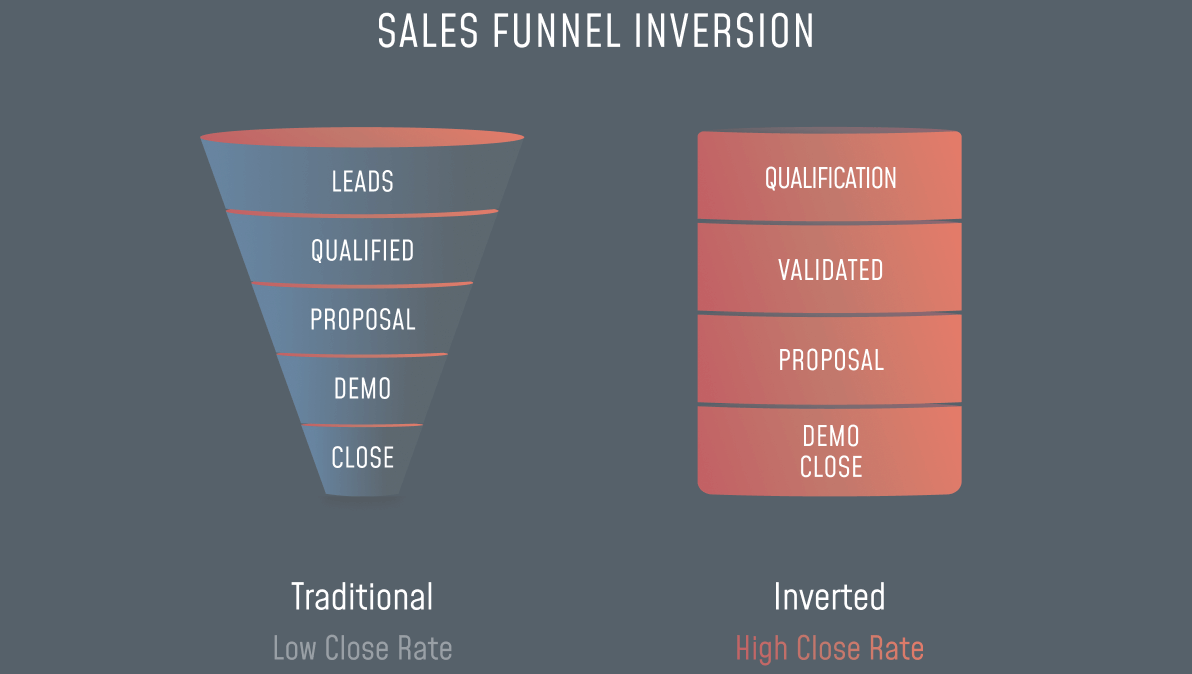
By rigorously removing the "maybe" buyers early, you reduce the denominator in your conversion equation. This lowers your Customer Acquisition Cost (CAC) and allows your top talent to focus 100% of their energy on the 20% of leads that will actually generate revenue.
Phase 2: Applying Behavioral Economics to Closing

Once the process is engineered to deliver the right prospects, the challenge shifts to closing. This is where Rose Garden Consulting differentiates itself by applying behavioral science.
Most sales training focuses on "handling objections." Behavioral economics focuses on preventing them by understanding the cognitive biases that rule the buyer's mind. Two specific forces often kill deals: Decision Fatigue and Status Quo Bias.
- Decision Fatigue: The more choices a buyer has to make, the more likely they are to make no choice at all.
- Status Quo Bias: The psychological preference for the current state of affairs. The pain of changing vendors often feels greater than the pain of staying with a subpar solution.
Guiding the Brain to Decision
To improve sales close rates, you must stop selling the "solution" and start selling the "decision."
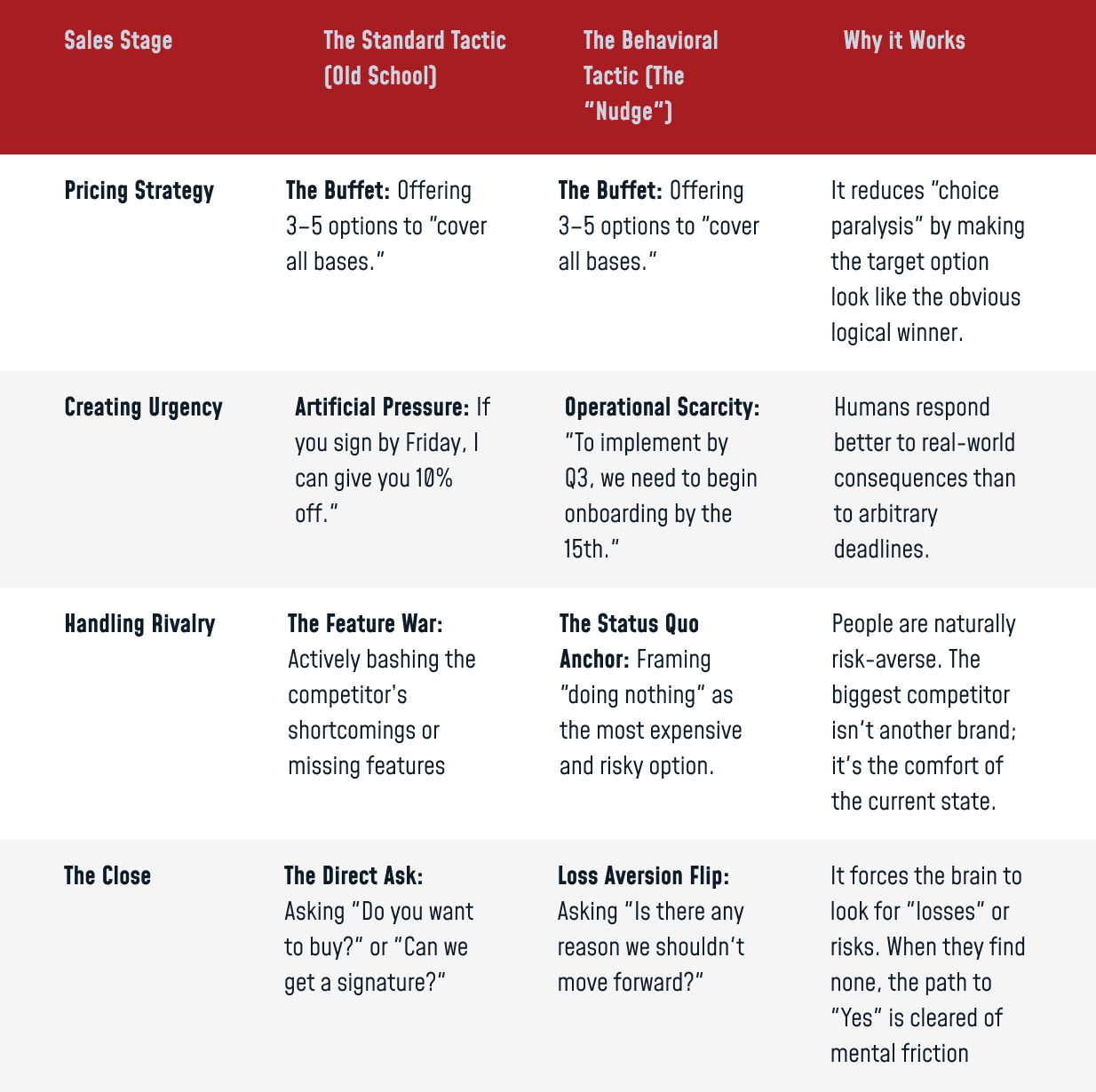
Comparison: Standard Tactics vs. Behavioral Tactics
The Decoy Effect in Action:
If you present a "Basic" plan at $500 and a "Pro" plan at $1,000, the buyer evaluates the price gap. If you introduce a "Plus" plan at $950 that offers significantly less value than the "Pro" plan, the "Pro" plan suddenly looks like a bargain. The "Plus" plan is the decoy—it is not meant to be sold; it is meant to frame the value of the target option.
By engineering the choice architecture, you reduce the cognitive load on the buyer, making it easier for them to say "yes."
Phase 3: Sales Team Performance Optimization and Culture

You can have the perfect process and the best psychological tactics, but they will fail without the right execution. This brings us to sales team performance optimization.
Many sales leaders confuse "management" with "optimization." Management is ensuring reps make 50 calls a day. Optimization is ensuring those 50 calls yield maximum revenue.
The Human Element: Performance Optimization vs. Management
Performance Optimization is the systematic improvement of sales capability through judgment-based coaching. Unlike Performance Management, which focuses on compliance with activity metrics (inputs), Optimization focuses on the quality of decision-making and execution (outcomes).
To scale past the Revenue Plateau, you must hire and train for traits that algorithms cannot replace: curiosity, resilience, and high emotional intelligence (EQ).
Cultural Alignment for High Conversion:
- Curiosity over Pitching: The best closers do not have the "gift of gab"; they have the gift of asking the right question. They peel back the layers of a prospect's problem until the cost of inaction is undeniable.
- Radical Accountability: In a high-performance culture, a lost deal is never blamed on "price" or "the market." It is analyzed as a breakdown in the process or the performance.
- Resilience: Rejection is constant. Optimization requires a culture where "no" is seen as a valuable data point, not a personal failure.
When you treat your sales team as high-performance athletes rather than factory workers, you shift the culture from "hitting quota" to "mastering the craft.
Measuring Success: Metrics That Actually Matter
If you are still measuring your team primarily by "dials made" or "talk time," you are optimizing for noise. To engineer revenue, you must track metrics that indicate the health of the system and the velocity of the sale.
How Do I Hit My Revenue Goals?
For B2B leaders grappling with stagnant growth, hitting ambitious revenue goals often feels like an uphill battle against increasing competition and buyer apathy. The traditional response—pushing for more activity—rarely yields sustainable results. Instead, achieving your revenue targets consistently requires a fundamental shift from a volume-centric to a conversion-centric sales strategy.
Hitting revenue goals in today's B2B landscape is less about brute force and more about strategic precision. It involves optimizing every stage of your sales funnel, leveraging insights from behavioral economics, and empowering your sales team with judgment-based coaching.
By focusing on converting a higher percentage of qualified leads, rather than simply generating more leads, you create a more predictable, scalable, and profitable revenue engine. This approach minimizes wasted effort, reduces customer acquisition costs, and positions your organization for sustained growth.
Explore more in-depth strategies to achieve and exceed your revenue targets.
Execution: Implementing the Blueprint

The transition from a "hustle culture" sales floor to a precision-engineered revenue machine does not happen overnight. It requires a willingness to tear down comfortable habits and rebuild based on data and psychology.
However, the results of this transformation are profound. Companies that adopt the High-Conversion Sales Blueprint frequently see their close rates double, their sales cycles shorten, and their revenue break through the plateau that once seemed insurmountable.
Strategy without execution is merely hallucination. To truly engineer growth, you must audit your process, train your people on the science of decision-making, and measure what matters.
Is your revenue stuck at a plateau? Stop guessing. Start engineering.
Book a Sales Process Audit with Rose Garden Consulting to identify the friction in your funnel and unlock your next stage of growth.
Capabilities


Ready to Build a Team That Delivers?
Explore how our programs solve the real issues behind underperformance.
Success Stories
See how we’ve helped our clients transform their sales teams from scattered to unstoppable.

Jean Tang
Ali Mirza turned our sales around. After a single day of training, he really opened up how we approach our sales in a difficult market. Our conversions with prospects have been fantastic—before, we'd lose out on revenue with disappearing prospects or people going in another direction..and we wouldn't understand why. Now, using techniques learned from Ali, 92% of our qualified audience base is interested in continuing the conversation, and we are harvesting an astounding 45% higher close rate than pre-Rose Garden. Plus he's a great guy who makes the learning fun. I can't recommend this business more highly.

Zach Burkes
If you know you should be selling more or that your team is underperforming -- don't waste another minute leaving money on the table. Call Rose Garden Consulting today to jumpstart your sales for 2022.

Jordi Rivera
Working with Ali has been great. He gave me actionable tips to elevate my sales teams performance and energy.
Julia Wittrock Hensel
Rose Garden Consulting is amazing! Their unique approach to understanding what prospects really want has been a game changer for our sales process. They provide great advice and very actionable feedback on sales calls - I am so grateful!
Moe Peyawary
Fantastic company. I'm out of Toronto and in a very competitive business. I must have interviewed about 15 different companies but wasn't convinced by their approach. Ali was very different, he provided me with a customized sales system for my business and I have not looked back since. I strongly recommend Ali and Rose Garden Consulting for anyone who takes their sales career seriously. Thank you again for the amazing work you do.
Wayne D.
RGC continues to surpass all expectations providing exceptional sales management consulting.

Benjamin Berman
My experience with Ali and Rose Garden has been nothing but fantastic and professional. Ali is always quick to respond and his insights are always appreciated. We have been so pleased with the above and beyond service that a number of our own clients signed on. Thank you Ali and Team!
Torrey T.
Highly recommend Rose Garden- you will love them after just one call with the team. Keep up the great work!
Chris Arnold
I was ready to move my sales team to the next level by adding a sales manager to our organization and by building an engaging compensation plan. Even though I knew what I wanted, my challenge was I didn't have all the pieces to build it. I was referred to Rose Garden by another business associate. Why Rose Garden was so valuable was that they quickly helped us build exactly what we needed. I walked away with a robust compensation plan and a road map for the sales manager I was ready to hire. What I learned was that I needed help building the plane before I stuck a pilot (sales manager) in it. This is what Rose Garden did so well. They helped me build the framework, systems and processes that I needed. It was a turn-key system handed to me. By the time the consulting was finished all we had to do was execute.
wayne deslauriers
RGC provides excellent sales support and consulting services. Ali has a very successful sales background supported by experience in a wide variety of industries. As a proven sales professional he has now redirected his energies to sharing his exceptional ability with a broad range of companies. This is unique in comparison to other consultants who tend to dwell on "Proven Sales Processes" delivered by skilled presentation staff often lacking in the exceptional sales career success evident with Ali. On meeting Ali for the first time, his talent and skill level becomes immediately evident. RGC truly has a new and refreshing approach.3
Ashlee S.
The team at Rose Garden Consulting is professional and working with them has been amazing. Their approach to sales is very unique and I would highly recommend them!
Ryan Lawson
Rose Garden is great. Ali is a no-nonsense, to the point, straight shooter and his approach was incredibly helpful in bringing clarity to our (fairly complicated) business this year. They came in, helped us organize, set KPI's, see the bigger picture across multiple departments. Highly professional, would recommend.
Tazscapes Inc.
The team at Rose Garden Consulting were an absolute pleasure to work with!
Their approach to understanding our company needs were very impressive - they took the time to not only efficiently train our sales staff but also educate us about the variety of sales protocols to implement so our company can maximize future sales potential.
They took the time to build out our sales process and give us strategic ways to close deals and Ultimately increase our sales revenue in such a short period of time!
We highly recommend Ali and his team as the best sales consulting company in Atlanta - their dedication to excellence, quality service and detailed and strategic implementation of sales training have helped us immensely!
Ali is the Top sales consultant in Atlanta - Hands down! Keep up the good work!!
Britton Daley
Ali Mirza gives clear, accessible sales training using examples that just make things “click”. His roleplaying exercises build confidence through modeling (and then embodying) successful sales techniques that get clients on your side. These techniques clearly demonstrate how to build lasting relationships. He also helps you get in the head of your leads, making follow ups more thoughtful and effective (and frankly, less painful to write). Highly recommend working with him to boost your sales.
Zarifa Bahran
Hardworking, knowledgeable and trustworthy! I had pleasure working with them.
Nick Roshon
I've worked with Ali & the RGC team over the last few years to keep my team and myself high performing - he has a no nonsense attitude and is willing to tell me the good, bad, and ugly of our sales process, which helps us stay sharp and gives a critical outsider perspective to keep us honest and sharp. His coaching is spot on, and if you have any doubts read his book - this man knows the craft and isn't just spewing the same outdated frameworks everyone else is.

About Us
Rose Garden Consulting is a collective of revenue generation experts who use behavioral economics to transform businesses.
Our vision: To fundamentally change how people buy and sell. Our promise: To help your organization break through revenue plateaus, reduce sales team turnover, and create sustainable growth systems.


Take Control of Your Sales Team Now
If your sales team has missed quota in the last 12 months, you should have us audit your sales process & sales calls. We will tell you exactly how you can increase your revenue by millions of dollars this year. If you don’t, you’ll continue to miss quota and you’ll not only lose valuable opportunities and revenue, but you’ll also lose good people from your sales team.